
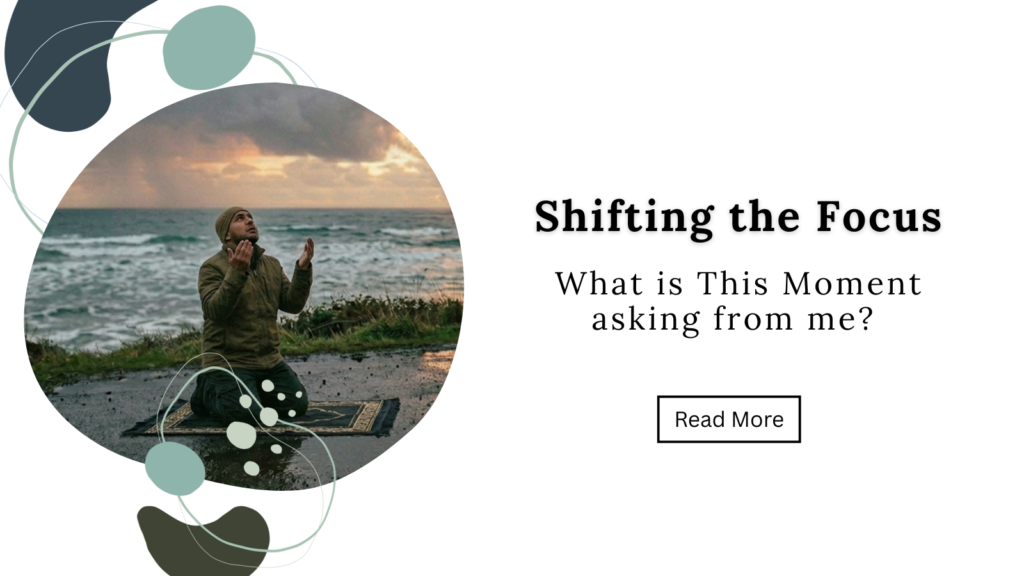
Oftentimes we find ourselves focused on the situation we are in. The hardship. The moment. The pressure. However, Islam encourages us to do something that is incredibly profound. To shift the focus from the situation itself to what is required of you in this situation.
This means you no longer find yourself hyperaware of what you’re going through, because you begin to shift your attention to what you should do during that situation you are put in.
Because every hardship, in its essence, is already decreed by Allah. And within that decree lies wisdom, mercy, and a love that is always present.
So the next level of awareness is not to remain anchored in the weight of the hardship, but to ask: What is Allah asking of me during this very moment? How am I meant to show up here?
When we begin to ask the right questions, we begin to live a more peaceful life that is focused on things within our control rather than outside our control.
Can you imagine how much our mental health will improve if we apply this perspective change?
Your car stops in the middle of the road. There are two kinds of reactions.
You can either ask: “Why did this happen? Why me?”
Or you can focus on your reaction and ask: “What does Allah want to see from me right now?”
That subtle change makes all the difference in the world. As a matter of fact, the moment itself now becomes a chance to prove yourself and try to be of those who are patient, thankful, and resilient in the face of hardship.
On the other hand, focusing on the car, and why it stopped, and being frustrated at the situation will only add more agitation, significantly increasing your anxiety.
And this is where something powerful begins to unfold within you.
Because the moment you shift your focus in this way, you are no longer a victim of your circumstances. You become someone who is actively responding, rather than passively reacting. And there is a very real psychological difference between the two.
When you react, you feel overwhelmed. Your thoughts spiral, your chest tightens, and your mind starts racing with “what ifs” and “why me’s.” This is where anxiety thrives. In the space where you feel out of control, where everything feels like it’s happening to you.
But when you respond, you reclaim a sense of control. Even if the situation itself doesn’t change, your position within it does. You are no longer drowning in the moment. You are standing within it, grounded, aware, and intentional.
This is deeply connected to mental health. So much of our emotional distress doesn’t come only from what we go through, but from how we interpret what we go through.
Two people can face the exact same hardship, yet one walks away stronger and more at peace, while the other feels broken and consumed. The difference often lies in the lens they choose to look through.
And Islam, in its depth, offers us a lens that is both grounding and healing.
It teaches us that hardship is not meaningless. That your struggle is seen. That your effort, even the quiet internal effort, is counted. That even the way your heart tries to remain steady in chaos is something that carries weight.
So instead of asking, “Why is this happening to me?” which is actually a question that often leads to frustration with no clear answer, you begin to ask: “What is required of me right now?”
And suddenly, your mind has somewhere to go.
Instead of looping in confusion, it begins to search for action, restraint, surrender and strength.
And this shift alone can significantly reduce emotional overwhelm.
Because your mind was never designed to sit endlessly in unanswered questions. It was designed to act and seek purpose.
This is why rumination (constantly replaying the situation, analyzing it, questioning it) is one of the biggest contributors to anxiety and emotional exhaustion. It traps you in a cycle where nothing resolves, yet everything feels heavier.
But when you redirect your thoughts toward what you can do, even internally, you interrupt that cycle.
You breathe a little easier. Think a little clearer. Feel a little lighter.
Not because the hardship disappeared, but because you are no longer carrying it in the same way. And this doesn’t mean you suppress your emotions or pretend everything is okay. Islam does not ask you to deny what you feel. It allows space for sadness and even tears.
But it gently guides you to not live in those emotions. To feel them, acknowledge them, and then move toward what brings you closer to Allah within that very moment.
So maybe what is being asked of you right now is patience. Not the passive kind, but the kind where you hold yourself together even when you feel like falling apart.
Or maybe it is gratitude. Finding something, even if it’s small, to anchor yourself in, so that the hardship doesn’t consume your entire perspective.
Or maybe it is trust . Choosing to believe that there is something unfolding here that you cannot yet see.
And sometimes, what is being asked of you is simply to pause. To not react immediately or say something you might regret. Even that is an act of strength in Islam.
Over time, this way of thinking builds something incredibly valuable within you: emotional resilience.
You begin to notice that you don’t spiral as quickly and what once overwhelmed you now feels more manageable. This kind of growth doesn’t happen overnight. It’s a process that involves constant returning.
Perhaps one of the most beautiful outcomes of this shift is the relationship it builds between you and Allah and instead of resisting your life, you begin to move through it with a sense of trust.
A quiet understanding that even when things don’t make sense, there is meaning and even when things feel heavy, there is mercy. At the very core of so much of our mental struggle is the feeling of being lost and not understanding why things are happening the way they are.
But this perspective gives you something steady to hold onto.
A direction that centers you and purpose within the moment itself.
Sometimes, all you need to feel better and be better is to slowly shift your perspective and look at your situation from a different angle.
And in that shift, you don’t just survive your moments but transform through them.
You become someone who is not easily shaken, because you are no longer anchored to outcomes, but to purpose. Someone who is not defined by what happens to them, but by how they rise within it.
So when life feels overwhelming, return to that question.
What is this moment asking from me?
And trust that whatever the answer is, meeting it with sincerity will change your life in ways you cannot begin to imagine.