
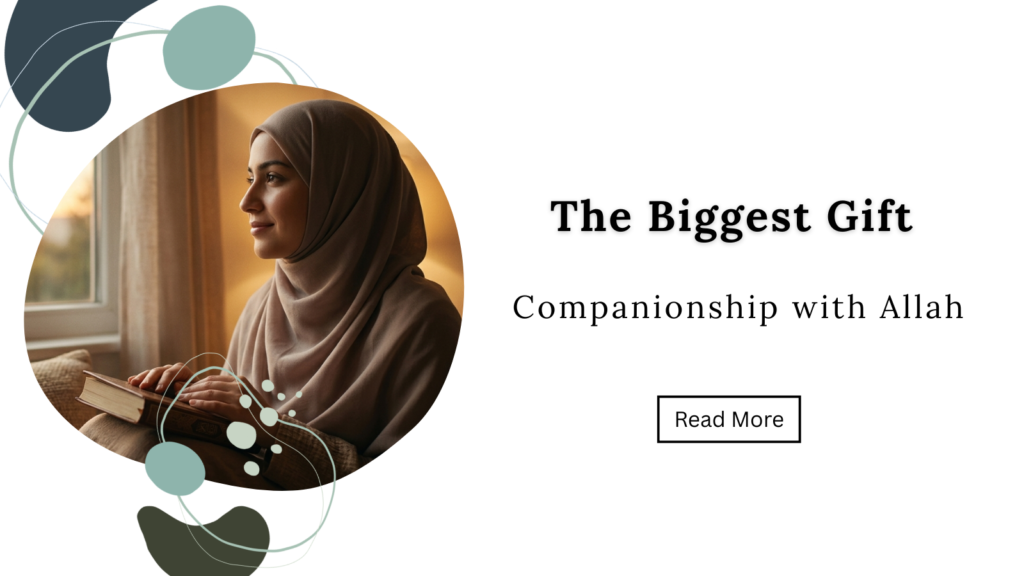
There is a beautiful concept in our religion known as الأُنسُ بالله (Al-unsu billāh), which refers to finding comfort and companionship with Allah. When someone experiences الأُنسُ بالله (Al-unsu billāh), they feel their happiest and most at peace in their connection with Allah (SWT).
When you begin to see Allah as your ultimate companion, life takes on an entirely different meaning. You no longer feel the need to fill every gap in your life with people.
Allah becomes more than enough for you.
This manifests in several ways:
You start to enjoy your own company. Silence no longer feels empty or heavy; it becomes a space where your heart can breathe. Moments that once felt lonely slowly transform into moments of connection, where a quiet dua, a whispered dhikr, or even a passing thought of Allah brings a sense of calm you didn’t have before.
You become less dependent on people for emotional validation. It’s not that you stop loving or valuing others, but your heart is no longer attached in a way that breaks you. You don’t seek constant reassurance, because you know that Allah sees you, hears you, and understands what you cannot even put into words.
There is a subtle shift in how you handle hardship. Instead of immediately searching for someone to ease the pain, your heart instinctively turns to Allah first. You find yourself speaking to Him more honestly, more vulnerably. And somehow, even before the situation changes, your heart feels lighter, because you are not carrying it alone.
Even your acts of worship begin to feel different. Prayer is no longer just something you complete. It becomes somewhere you return to. A pause in your day where you stand in front of the One who knows you completely, yet still welcomes you every single time.
And perhaps the most beautiful sign of الأُنسُ بالله (Al-unsu billāh) is this: you no longer fear being alone.
Because you aren’t. All verses in the Quran actually confirm this beautiful truth:
وَإِذَا سَأَلَكَ عِبَادِي عَنِّي فَإِنِّي قَرِيبٌ ۖ أُجِيبُ دَعْوَةَ الدَّاعِ إِذَا دَعَانِ
“And when My servants ask you about Me, indeed I am near. I respond to the call of the caller when he calls upon Me.” (2:186)
وَهُوَ مَعَكُمْ أَيْنَ مَا كُنتُمْ
“And He is with you wherever you are.” (57:4)
وَلَقَدْ خَلَقْنَا الْإِنسَانَ وَنَعْلَمُ مَا تُوَسْوِسُ بِهِ نَفْسُهُ ۖ وَنَحْنُ أَقْرَبُ إِلَيْهِ مِنْ حَبْلِ الْوَرِيدِ
“And We have already created the human being and know what his soul whispers to him, and We are closer to him than his jugular vein.” (50:16)
مَا يَكُونُ مِن نَّجْوَىٰ ثَلَاثَةٍ إِلَّا هُوَ رَابِعُهُمْ وَلَا خَمْسَةٍ إِلَّا هُوَ سَادِسُهُمْ وَلَا أَدْنَىٰ مِن ذَٰلِكَ وَلَا أَكْثَرُ إِلَّا هُوَ مَعَهُمْ أَيْنَ مَا كَانُوا ۖ ثُمَّ يُنَبِّئُهُم بِمَا عَمِلُوا يَوْمَ الْقِيَامَةِ ۚ إِنَّ اللَّهَ بِكُلِّ شَيْءٍ عَلِيمٌ
“There is no private conversation among three except that He is their fourth, nor among five except that He is their sixth—nor fewer than that nor more except that He is with them wherever they are. Then He will inform them of what they did on the Day of Resurrection. Indeed, Allah is Knowing of all things.” (58:7)
أَلَيْسَ اللَّهُ بِكَافٍ عَبْدَهُ
“Is Allah not sufficient for His servant?” (39:36)
And so…with all these beautiful verses and reassurances you begin to realize that what you were searching for in people, that comfort, understanding, and constant presence was actually always found in Allah.
Once your heart tastes that kind of companionship, it changes what “enough” truly means.
The question herein lies… how does this tie to Islamic psychology and mental health?
In Islamic psychology, the human being is understood as not just a physical or emotional entity, but a deeply spiritual one. The قلب (heart) is seen as the center of perception, attachment, and emotional stability. When the heart is constantly seeking security from creation alone, it becomes vulnerable. This is because people are limited, inconsistent, and imperfect. But when the heart becomes attached to Allah, it finds something unshakable.
This is where الأُنسُ بالله (Al-unsu billāh) becomes more than a spiritual idea. It becomes a form of emotional grounding. Psychologically, many struggles such as anxiety, emotional dependency, and loneliness stem from over-attachment to what can change or be lost. Islamic teachings gently redirect this attachment, not by removing love for people, but by re-centering the heart on the One who never leaves.
This shift does something powerful internally: it reduces emotional fragmentation. Instead of scattering your need for validation, reassurance, and stability across different people, your heart begins to unify its dependence on Allah. And paradoxically, this does not isolate a person. It stabilizes them.
A heart anchored in Allah is less shaken by absence, rejection, or silence from others.
It also reframes loneliness itself. In modern psychology, loneliness is often defined as the absence of connection. But in Islamic understanding, you are never truly “alone” in that absolute sense. You may be physically by yourself, but spiritually, you are always in the presence of Allah. This transforms solitude from something empty into something meaningful.
Even emotionally, this companionship changes how pain is processed. Instead of suppressing feelings or over-relying on human support, the believer is taught to turn directly to Allah in dua, reflection, and remembrance. This creates a form of emotional release that is both spiritual and therapeutic.
Ultimately, الأُنسُ بالله (Al-unsu billāh) is not an escape from human life. It is what allows a person to live it with balance. To love without dependency, to feel without breaking, and to be alone without feeling abandoned. And that is where mental peace begins: not in having everything around you, but in having Allah within your heart.
When you work on having Allah as your companion, you begin to be more at ease, more relaxed and less inclined to be upset with people. Emotional resilience is built and a sense of identity is also created.
When you work on having Allah as your companion, you begin to feel more at ease, more grounded, and less easily shaken by people or their actions. Things that once triggered emotional reactions start to lose their weight, not because you stop caring, but because your heart is no longer dependent on human validation to feel stable.
Emotional resilience begins to form quietly over time. You don’t become emotionless. You become anchored. You start to respond rather than react, to reflect rather than spiral. And with that, a deeper sense of identity begins to take shape. You are no longer defined by how people treat you, or how they see you, but by who you are with Allah.
This shift is subtle, but powerful. You begin to understand that not every misunderstanding needs to break you, not every absence needs to hurt you, and not every opinion needs to shape you. There is a kind of inner steadiness that develops when your worth is no longer negotiated in human spaces, but rooted in divine awareness.
And as this internal stability grows, something even more beautiful happens: your relationships begin to change too. You become calmer in your interactions, more forgiving in your responses, and less reactive in moments of tension. Not because life becomes easier, but because your heart is no longer easily unsettled.
In this way, الأُنسُ بالله (Al-unsu billāh) refines the way you engage with people. It teaches you balance: to love without losing yourself, to care without collapsing emotionally, and to be present with others while still being anchored in Allah.
And slowly, you realize that peace was never about controlling the world around you… but about settling the world within you.