
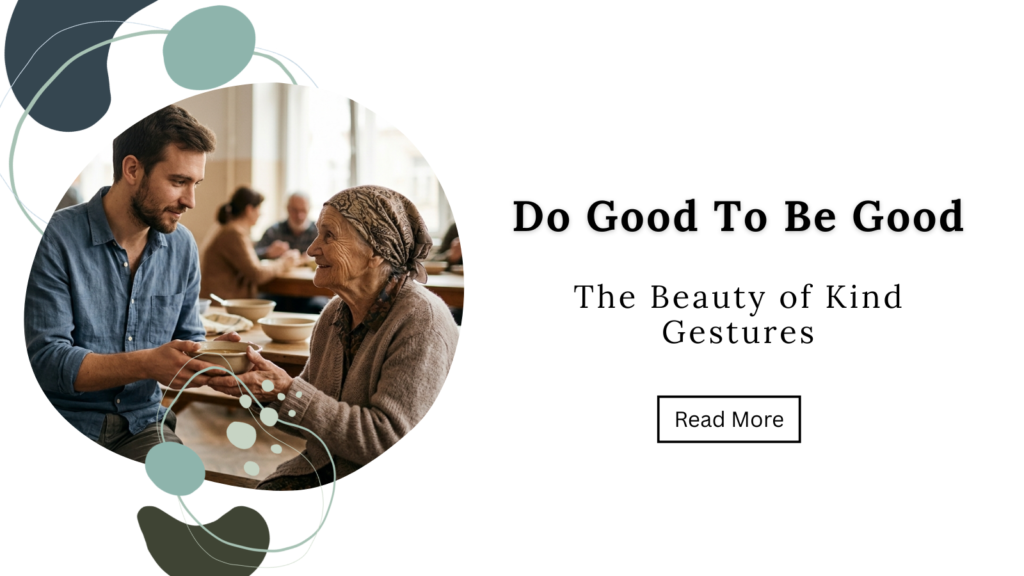
Modern psychology talks about the effect of kind gestures and how they positively affect our lives. When you give money to someone in need, help the elderly, or call your relatives just to check up on them, something shifts internally. You don’t just feel good about yourself for a moment, you actually begin to become good.
Sometimes, we assume it works the other way around. That you have to already be a good person in order to do good things. That kindness is a reflection of who you are, not something that builds who you are.
But in Islam, there is a concept that gently challenges this idea.
That we do good things to become good people.
This concept doesn’t just elevate your spirituality; it quietly transforms your mental state. It makes you calmer, more grounded, more at ease with yourself and the world around you.
Because suddenly, goodness is no longer something distant or intimidating. It becomes something you practice daily, even on days when your heart feels heavy.
This idea is built on a simple belief: what we do shapes our hearts. Instead of waiting for a moment of clarity, or a sudden personality shift, or the “right mood” to do something good, you just begin. You move first, and your heart follows.
In Islam, this is deeply connected to the concept of Tazkiyah, the purification of the soul. And Tazkiyah is not passive. It’s not something that happens to you. It’s something you do. Think of your character like a muscle. You don’t wait to become strong before going to the gym. You go to the gym precisely because you are not strong yet.
The same applies to your soul.
When you choose patience over irritation, generosity over stinginess, or kindness over indifference, you are actively training your heart. You are moving it, slowly but surely, from Al-Nafs al-Ammarah (the self that pulls you toward what is easy and impulsive) to Al-Nafs al-Mutma’innah (the self that is calm, content, and at peace).
This internal shift is not loud. It doesn’t always feel dramatic. But it is one of the most meaningful transformations a person can experience.
Allah captures this quiet victory in the Quran:
قَدْ أَفْلَحَ مَن زَكَّاهَا وَقَدْ خَابَ مَن دَسَّاهَا
“He has succeeded who purifies it [the soul], and he has failed who buries it.”
— Surah Ash-Shams (91:9–10)
Notice how purification here is described as something that leads to success. Not talent, not perfection, but the act of continuously working on your soul.
And that’s where “doing” becomes so powerful.
Because every time you choose to do something good, especially when you don’t feel like it, you are gently breaking the hold your ego has over you. You are telling your lower self that it is not in control. That you are capable of choosing something higher, even in discomfort.
At first, it feels forced. A kind word that doesn’t come naturally. A small act of generosity when you feel like holding back. A moment of patience when you want to react.
But over time, something shifts.
These small actions begin to form patterns.
And those patterns become habits.
And those habits slowly become who you are.
Your default changes.
What once felt unnatural becomes instinctive. What once required effort begins to flow with ease. And this is the quiet power of consistency. You are, without realizing it, rewriting the emotional and spiritual responses of your heart.
There is also a subtle feedback loop that begins to form. After a good deed, there is often a sense of lightness, a quiet peace that settles within you. It’s not always overwhelming, but it’s there. That feeling is not random. It is a sign that your internal state is beginning to align with your external actions.
Your heart recognizes goodness, even before it fully embodies it.
And this is why the idea of “fake it until you make it” takes on a completely different meaning here. If you feel angry, give a gift. If you feel distant, reach out. If you feel selfish, give something away. If you feel lonely, be there for someone else.
You are, in a way, building yourself from the outside in. And nothing improves your mental health the way these kind gestures do.
There is also a deep, almost paradoxical truth in this process: when we are hurting, our instinct is to turn inward, to isolate, to focus on our own pain. But often, the fastest way to soften that pain is to step outside of it and ease someone else’s.
When you comfort someone who is struggling, your own problems begin to feel lighter. When you give to someone in need, your attachment to what you have starts to loosen. When you show up for others, you begin to feel less alone.
Kindness, in this sense, is never one-directional. It travels outward, but it always finds its way back. It returns to you softer, deeper, more meaningful.
And slowly, it changes you.
It makes you less harsh, both toward yourself and toward others. Because once you begin working on your own soul, you realize how complex that process is. You become more understanding, more patient, more aware that everyone is carrying something unseen.
You stop expecting perfection from people, because you are witnessing firsthand how gradual growth truly is.
This is why the life of the Prophet (peace be upon him) focused so heavily on actions. For twenty-three years, he taught people how to treat one another, how to speak, how to respond, how to give, how to forgive. These were not small teachings.
They were the foundation of a healthy heart and a balanced society.
Because actions shape hearts. And hearts shape lives.
If you want to begin this journey, it doesn’t require anything overwhelming or complicated. In fact, the beauty of it lies in how simple it can be.
Start small, but start intentionally:
- Choose one internal act. Forgive someone, even if they never asked for it. Let go of something you’ve been holding onto. This cleans something inside you that no one else can see.
- Choose one verbal act. Say something kind to someone you usually overlook. A sincere compliment, a gentle word, a moment of acknowledgment. This softens your tongue and reshapes how you interact with the world.
- Choose one physical act. Give something. It doesn’t have to be big. A small amount of charity, your time, your effort, your presence. This loosens the grip that attachment has on your heart.
And don’t underestimate these small steps.
Because over time, they build something much bigger than you expect.
They build a version of you that is lighter, more peaceful, and more aligned with what truly matters.
A version of you that doesn’t wait to be good in order to do good, but understands that sometimes, doing good is exactly what leads you there. And maybe that’s the real beauty of kind gestures.
They are not just things you give to others.
They are pathways you create for your own heart to find its way back to peace.