
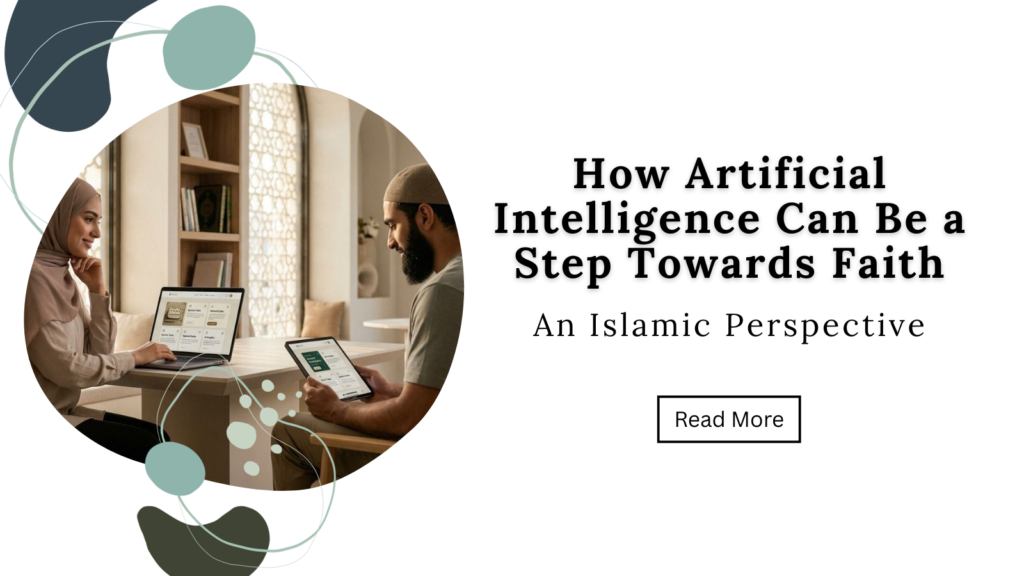
The era of Artificial Intelligence has begun and it continues to transform the way we live our lives. From helping us manage our schedules more effectively, providing therapeutic support, and aiding our educational development, AI is quickly becoming one of the most important aspects of our everyday lives. Muslims face an exciting yet confusing challenge in dealing with this technological breakthrough.
Can something as advanced as AI be beneficial to our religious journey?
Or is it likely to lead us away from it?
As counterintuitive as it might seem, with enough wisdom and purpose, AI can help us get closer to our faith.
The Misconception: “AI Will Replace Spirituality”
One of the major concerns about the emergence of AI is the fear that it will replace spirituality. A lot of people wonder whether technology can actually make people less sincere.
Islam has always been based on moderation. Allah has gifted mankind with intelligence, imagination, and innovation. Muslims have long incorporated new technologies (such as the internet or printing press) in their efforts to safeguard knowledge and disseminate it.
Technology is neutral. There is nothing that will ever undermine revelation or challenge divinity. That is impossible. Technology is only a means that will either harm you or benefit you depending on your intention and how you use it.
1. AI as a Path to Seeking Knowledge
Seeking knowledge is a core principle in Islam. The first revelation of the Quran was the word “Iqra,” meaning read. AI tools can help Muslims gain access to Islamic knowledge like never before.
Muslims are now able to:
- Explore Quran tafsir in a structured and understandable way
- Gain knowledge about authentic hadith
- Learn about the history of Islam and prophets
- Develop Arabic grammar skills and practice tajweed with feedback
- Undergo an individualized study program depending on their level
For most people, the problem is not a scarcity of sources; rather, it is the lack of consistency. This is where AI comes in. By dividing important teachings into smaller chunks and engaging users interactively, AI helps fill this void and makes learning easier.
More importantly, it does not replace scholars. Rather, it assists the student of knowledge in seeking it. AI serves as a guide, helping users navigate vast amounts of information, while scholars continue to be the ultimate authority on interpretation and rulings.
2. Promoting Mental and Emotional Well-Being
In today’s fast-paced world, many Muslims are silently struggling with anxiety, unwanted thoughts, trauma, stress, and self-doubt. These struggles can deeply impact one’s connection with Allah.
AI-powered tools can actually help promote mental and emotional well-being from an Islamic perspective. They can gently guide users toward:
- Increased mindfulness and self-reflection
- Comforting Quranic verses
- Guidance through dua
- Coping strategies aligned with sabr (patience) and tawakkul (trust in Allah)
Such tools can complement professional therapy or Islamic counseling. They are not replacements for human care, but they can provide immediate, private, and consistent support.
This is particularly helpful for Muslims who may be hesitant to talk about their issues or lack access to trained counselors.
3. Reviving Dhikr, Salah, and Awareness
The most significant problem in contemporary society is distraction. Most people spend their lives in a hurry, often forgetting why they are here in the first place.
AI can be used to restore spiritual awareness by providing reminders that become a part of daily routine. These reminders include:
- Exact timings for prayers
- A realistic plan for reading Quran
- Habit-building tools for salah
- Mindfulness prompts rooted in gratefulness, patience, and trust
Small as these reminders may seem, they actually make a difference. One reminder to stop, think, and make dhikr can gently start transforming ordinary routine into acts of remembrance.
4. Personalized Islamic Growth
One of AI’s most powerful features is personalization. Every individual’s spiritual journey is unique. Some struggle with consistency in prayer, others with doubt, burnout, or emotional hardship. AI can tailor support based on individual needs, creating a more meaningful and relevant experience.
For example:
- Someone struggling with waswasa (intrusive doubts) may receive calming verses
- A person experiencing burnout may receive reflections on rest and balance in Islam
- A beginner may receive simplified explanations, while advanced learners receive deeper insights
Such a personalized experience could become an effective tool for tazkiyah (purification of the soul), enabling people to grow at a pace that fits them.
5. Expanding Access for Converts and Reverts
For many new Muslims, the initial phase of their Islamic experience can be quite daunting.
AI can support converts and reverts through:
- Beginner-friendly lessons that simplify core concepts
- Assistance with Arabic pronunciation and how to recite the Quran
- Answers to all their frequently asked questions
- Encouragement and motivation to continue learning
This support can reduce feelings of loneliness and confusion. It gives new Muslims a sense of companionship and direction, especially during moments of doubt or uncertainty.
Using AI Wisely: The Islamic Guidelines
While AI offers many benefits, Islam teaches intentionality and caution. Even beneficial tools can become harmful if used without proper boundaries.
To guarantee that AI remains a positive influence, certain principles should be followed:
- AI should never replace fatwas (independent religious rulings)
- Information provided by AI needs to be checked using the Quran and Sunnah
- It should assist us but not substitute scholars and tutors
- It should encourage humility rather than arrogance
- It should not make us dependent on technological advancement
AI: The means, not the end
Over the course of history in Islam, tools have evolved, but the intent has been the same: getting closer to Allah.
Pen has been revolutionary before. So was printing. Then digitalization revolutionized global education. And now, AI is simply the next step in this progression.
These developments can help Muslims re-connect with:
- The Quran
- The meanings behind the Quran
- True Islamic knowledge
- Emotional and spiritual healing
- Purposefulness in life
However, it is essential to remember: AI is a means, not an end. It is not the source of guidance. Allah is.
The believer constantly asks: How can I use this to get closer to Allah?
And last but not least…
AI is not inherently a threat to faith. In fact, when used with sincerity, discipline, and awareness, it can become a stepping stone toward greater understanding, mindfulness, and connection with Allah.
The digital age does not have to weaken spirituality. It can refine it.
The responsibility lies with us. To use it wisely. To always remain grounded.
And to ensure that every tool we adopt ultimately brings us closer to the One who created all knowledge in the first place.