
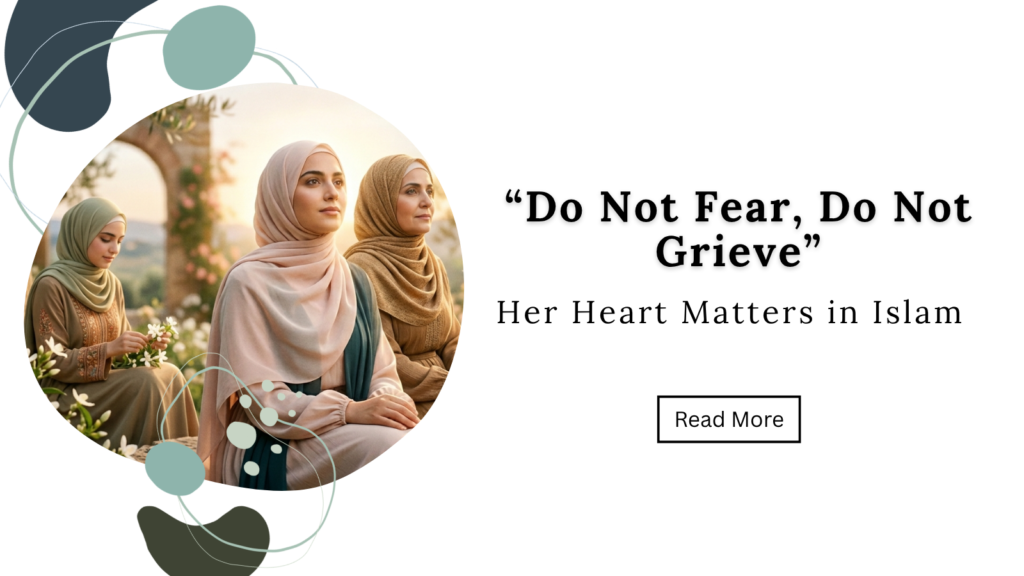
There is something really comforting about how women are addressed by Allah in the Quran. Again and again, across different stories and moments of vulnerability, one message is repeated with striking consistency: do not fear, do not grieve.
This repetition is not random. It is deeply intentional. It reflects an understanding of the emotional depth Allah created within women and their capacity to feel intensely, to carry silently, and to endure more than what is often visible on the surface.
When we begin to look closely, we notice a pattern in the Quran. Allah does not ignore the emotions of women. He, with His mercy, addresses those emotions directly, especially in their most difficult moments.
Take, for example, the story of the mother of Musa (AS). Imagine the weight of placing your own child into a river, not knowing what will happen next. It is a moment filled with fear, uncertainty, and unimaginable pain.
Yet in that moment, Allah does not only give her instructions…He comforts her heart:
وَلَا تَخَافِي وَلَا تَحْزَنِي
“Do not fear, nor grieve.”
— (Surah Al-Qasas 28:7)
Later in the same story, Allah reveals the wisdom behind what unfolded:
كَيْ تَقَرَّ عَيْنُهَا وَلَا تَحْزَنَ
“So that her eye may be comforted and she may not grieve.”
— (Surah Al-Qasas 28:13)
Notice how central these reassurances are. Allah acknowledges her fear and her grief, and then gently soothes both. It is a reminder that emotional pain is not dismissed in Islam.
It is recognized and cared for.
A similar moment appears in the story of Maryam (AS). She experienced childbirth alone, was physically exhausted, emotionally overwhelmed, and isolated from any human support. In that state, where grief can easily take over, Allah sends her a simple yet powerful message:
فَنَادَاهَا مِن تَحْتِهَا أَلَّا تَحْزَنِي
“So a voice called her from below her, ‘Do not grieve.’”
— (Surah Maryam 19:24)
There is something deeply moving about the simplicity of these words. No lengthy explanation, no complex reasoning…just a direct address to her heart. Because sometimes, reassurance is what the heart needs before anything else.
Even in the lives of the wives of the Prophet ﷺ, Allah highlights the importance of their emotional well-being:
أَن تَقَرَّ أَعْيُنُهُنَّ وَلَا يَحْزَنَّ
“So that their eyes may be comforted and they may not grieve.”
— (Surah Al-Ahzab 33:51)
This repeated emphasis shows us something profound: a woman’s emotional peace matters. Her sense of comfort and her ability to feel at ease are not secondary concerns in Islam.
From a psychological perspective, a woman’s emotional pain does not remain in the heart alone. It travels through the body. Persistent grief and stress can activate the body’s stress response system, increasing cortisol levels and affecting sleep, energy, and emotional regulation. Over time, this can lead to anxiety, emotional exhaustion, and even physical symptoms such as fatigue, hair loss, and hormonal imbalance.
A woman’s emotional state and physical well-being are deeply intertwined. Her heart and body are not separate systems, but one deeply connected experience.
This is why emotional heaviness often feels far deeper than simple sadness. It is not something imagined. It is something felt in the body, carried in the mind, and reflected in daily life.
And so, when Allah repeatedly says “do not fear, do not grieve,” it is a merciful reminder from the One who knows us best, who understands how deeply sorrow can reach into a woman’s entire being, and how gently it must be met.
More importantly, Allah does not command women to suppress their feelings. He does not say do not feel. Instead, the message is gentle and healing: do not be consumed by fear and grief.. Do not let it define your entire inner world.
There is always a way through, and you are not alone.
This same gentleness is reflected in the teachings of the Prophet ﷺ. He said:
“استوصوا بالنساء خيرًا، فإن المرأة خُلِقَت من ضلع…”
“Treat women well, for woman was created from a rib…”
— Sahih al-Bukhari (3331), Sahih Muslim (1468)
And in another narration:
“رفقًا بالقوارير”
“Be gentle with the delicate vessels.”
— Sahih al-Bukhari (6149), Sahih Muslim (2323)
The description of women as “delicate vessels” is a beautiful recognition of value because if something is delicate, it is not dismissed. It is handled with care. It is protected because it is precious.
This naturally extends into how we treat the women in our lives. Islam does not frame kindness toward women as optional. It actually frames it as a reflection of one’s character and closeness to Allah.
The Prophet ﷺ said:
“خيركم خيركم لأهله”
“The best of you are those who are best to their families.”
— Sunan al-Tirmidhi (3895)
This includes the small, everyday moments that are often overlooked. The way we speak to our mothers. The patience we show our sisters. The attention we give our wives. The warmth we offer our daughters.
These are not small details. They shape emotional safety.
A careless word can linger in a woman’s heart longer than we realize, and a sincere act of gentleness can heal.
For the woman reading this, the message of “do not fear, do not grieve” is a reminder that your emotional world is acknowledged and your heart is under divine care. It is a reassurance that what you are feeling is not unknown to Allah. That the heaviness you carry is not unnoticed. Even when you feel overwhelmed, you are not alone.
And for those around her, this message is also a responsibility. Be mindful of her heart. A lot of women carry deeply and quietly. Your tone, your patience, and your presence? These are not small things. They are part of how emotional safety is built or broken.
In the end, there is a soft mercy that runs through the Quran and it can always be found in the repeated, steady reminders that meet the heart exactly where it is.
“Do not fear.”
“Do not grieve.”
These are not just verses to be read. They are words meant to remind every woman that her emotional world is not overlooked by Allah.
And perhaps that is the deepest form of protection and reassurance a heart can ever have.