
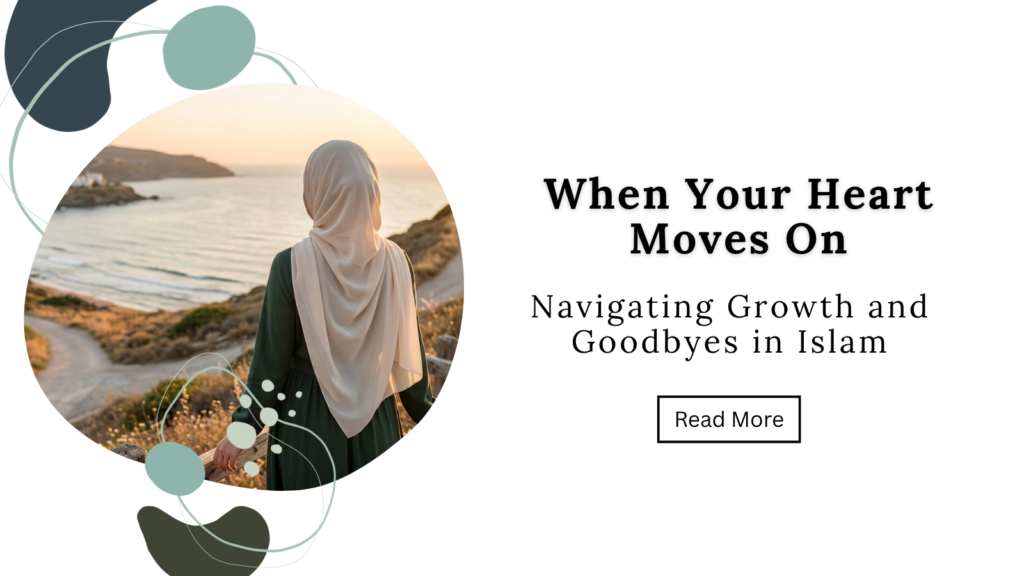
There’s a specific kind of heaviness that comes when you realize you’re changing, but your circle isn’t. You might find that the jokes you used to laugh at now feel a bit hollow, or the places you used to hang out at feel spiritually draining rather than fun.
These feelings aren’t arrogance and it doesn’t mean you’re being disloyal. It’s actually a sign of a heart that is waking up. Islam gives us a beautiful, compassionate framework to understand why we outgrow people and how to handle it without losing our akhlaq (character).
1. It’s Okay to Outgrow the “Old You”
Sometimes your heart moves before your life does. You start craving quiet over noise, and sincerity over small talk. The Prophet ﷺ often made the dua: “O Turner of hearts, keep my heart firm upon Your religion.” This reminds us that our hearts are never in the same state (qalb literally comes from the root meaning “to turn” or “to flip”). As you grow closer to Allah, you find yourself changing. Not everyone can (or is meant to) keep up with that pace. Some people enter our lives as lessons, some as mirrors, and others as temporary companions for a specific season of our lives. When a relationship starts to feel uncomfortable, it may be because you’re growing, and it no longer fits who you’re becoming.
2. Embracing the Stranger Within
The Prophet ﷺ said, “Islam began as something strange and will revert to being strange as it began, so give glad tidings to the strangers.” Growth can sometimes feel lonely. You might feel like a stranger in your own childhood bedroom or among friends you’ve known for a decade. This feeling of being different is actually something honored in the Prophetic path. When you choose to stop engaging in backbiting, or you decide to prioritize your prayers over a late-night outing, you are choosing a path that many won’t understand.
Do not let the fear of being “weird” or “different” pull you back into habits that no longer serve your Akhirah (Afterlife). Being a “stranger” among people is better than being a stranger to your own soul and to Allah.
3. Boundaries Aren’t Walls…They’re Filters
In our community, we often struggle with saying “no” because we don’t want to seem rude or un-Islamic. But Islam actually encourages us to be intentional about our inner circle. The Prophet ﷺ famously said that a person is upon the religion of their close friend, so let each of you look to whom he takes as a friend.
Setting a boundary isn’t about shutting people out; it’s about protecting your peace. Think of your energy as a limited resource. If a certain environment pulls you back into old habits, triggers your anxiety, or drains your spiritual battery, creating space is an act of self-preservation. Try to surround yourself with people who make it easy to remember Allah. To do so, you don’t need a big, dramatic ending or a difficult confrontation. You can gently limit your time, decline specific invitations, and redirect your energy toward environments that nourish you.
4. The Psychology of Attachment vs. Spiritual Alignment
We often stay in friendships just because we’ve known someone for a long time. But what really matters is shared values and spiritual connection, not just time.
In Islamic psychology, the nafs (self) is constantly evolving. If your nafs is striving for Mutma’innah (peace/tranquility) while your circle is rooted in Ammarah (the self that inclines toward lower desires), that gap will eventually cause burnout.
Recognizing this isn’t you judging them; it is an honest assessment of your current needs.
5. Outgrowing vs. Looking Down on Others
There is a thin line between spiritual growth and spiritual pride (kibr). One of the greatest tests of outgrowing a circle is how you treat the people you leave behind. You can recognize that your paths are diverging while still maintaining deep respect for where they are on their journey.
- Keep the Dua: You can love someone from a distance and keep them in your prayers. In fact, praying for their guidance is a sign of a healthy heart.
- Keep the Kindness: You don’t need to point out their flaws or lecture them to justify your distance. Simply move with grace.
- Keep the Humility: Never forget that you were once where they are. Only by Allah’s mercy and Hidayah (guidance) did your heart shift. You are a work in progress, just like them.
6. Trust the Process of “Clearing Space”
Growth is often uncomfortable because it requires letting go before the new change starts. This middle ground is where most people give up and go back to their old circles out of loneliness.
Sometimes, Allah removes people from your life because He is protecting you from influences you aren’t even aware of. Other times, He creates a period of solitude so that you learn to rely entirely on Him instead of social validation.
When you let go of connections that no longer serve your soul, you are making room for:
- Sincere Friendships: People who love you for the sake of Allah and push you toward goodness.
- Emotional Maturity: The ability to be alone without feeling lonely.
- Tawakkul: A deeper trust that Allah knows who belongs in your future and will provide the right companions at the right time.
7. Dealing with the Guilt of “Leaving People Behind”
Shaitan often uses guilt to keep us tethered to toxic environments. He whispers that you are being “fake” or that you are “abandoning” your friends.
Counter this by remembering that you cannot pour from an empty cup. If you stay in an environment that causes you to slip in your faith or character, you aren’t helping your friends, you’re just sinking with them. By stepping away and bettering yourself, you actually become a more effective light for them in the future. You can only pull someone up if you are standing on higher, firmer ground.
8. Practical Steps: How to Move Forward with Grace
If you feel the transition happening right now, try to shift your focus to these three “Heart-Checks”:
- Check your intention: Ask yourself, “Am I distancing myself because I feel superior, or because I am afraid of losing my connection with Allah?” If it’s the second option, you are on the right track.
- Choose silence over conflict: You don’t always need to explain why you’re changing. People who aren’t on the same path often won’t understand your “why,” and trying to explain it can lead to unnecessary arguments. Let your actions and your new character speak for you.
- Change your “Digital Circle”: Outgrowing people isn’t just about physical presence; it’s about whose content you consume. If the people you follow on social media make you feel worldly, insecure, or distracted from your purpose, it’s time to “unfollow” with the same grace you use in real life.
9. The Beauty of the New Arrival
Eventually, that gap will be filled. Allah says in the Quran, “And whoever fears Allah He will make for him a way out and will provide for him from where he does not expect.”
This includes companionship.
One day, you will find yourself in a room with people where the conversation flows naturally toward growth, where your silence is respected, and where your love for Deen is celebrated rather than mocked. These are the people Allah was preparing you for while you were busy mourning the friends you outgrew.
Conclusion: Your Soul Deserves Room to Breathe
Islam doesn’t ask you to shrink yourself to fit into old boxes. It doesn’t ask you to compromise your values to maintain loyalty to a group that hinders your journey. It asks you to honor the person you are becoming, the version of you that Allah is calling toward Him.
Walk the path that leads you closer to peace, even if you have to walk it alone for a while.
The right people will eventually meet you on that road.