
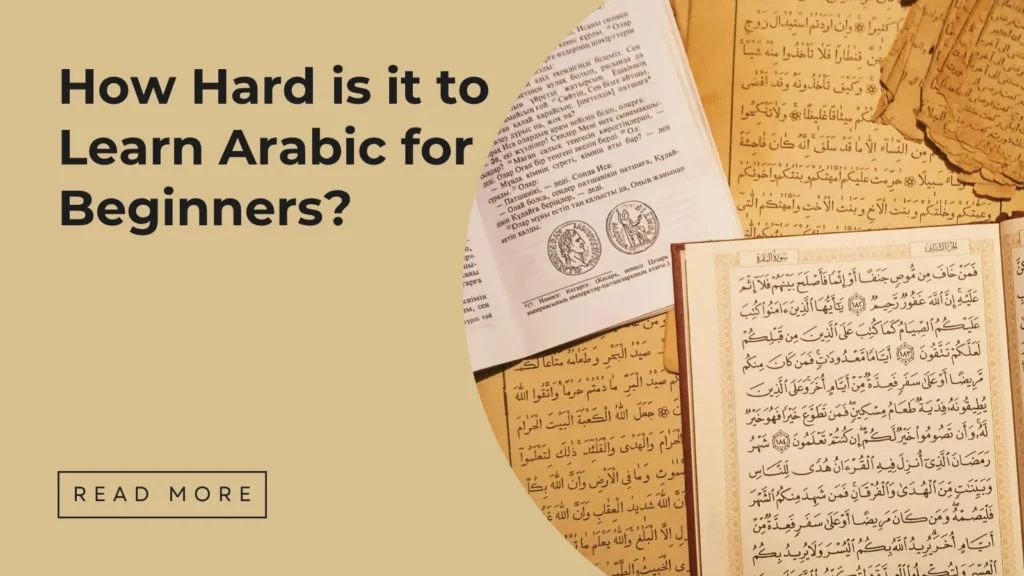
“How hard is it to learn Arabic?” This is a question that frequently arises for people considering Arabic as a new language. For English speakers, the answer can seem discouraging at first.
The alphabet looks entirely different. The words sound unfamiliar. The structure of sentences feels upside down. Additionally, Arabic has many dialects, each with a distinct sound, varying by country.
So yes, the question “how hard is it to learn Arabic?” deserves a proper answer. It’s not easy, but it’s also not impossible. The key lies in understanding what you’re up against and employing effective strategies to overcome it.
One of the significant reasons people ask, “How hard is it to learn Arabic?” is its complex grammar. Arabic employs a root-and-pattern system, where most words derive from three-letter roots.
This system can be confusing at first. There are also gender-specific verbs, dual forms, and verb conjugations that can make your head spin.
For example, the verb “to write” can change drastically depending on who is doing the writing, when it is done, and to whom it is addressed. It’s not just “write, wrote, written” as in English. It’s a whole tree of possibilities.
Arabic contains sounds that don’t exist in English. Letters like ع (‘Ayn), ح (Ha), and ص (Sad) are hard to pronounce at first. For many beginners, the question isn’t just “how hard is it to learn Arabic,” but also “how do I even pronounce this?”
But pronunciation improves with listening. Watching Arabic TV shows, listening to the Quran, or repeating words after a tutor helps your tongue adjust over time.
The Arabic alphabet has 28 letters and is written from right to left. That alone can feel like learning to write with your non-dominant hand. On top of that, most vowels aren’t written. This makes reading for beginners especially tough.
Still, learning the Arabic alphabet is possible within a few weeks. Use flashcards, tracing apps, and practice writing daily. It’s the foundation you need to move forward.
Another reason people wonder “how hard is it to learn Arabic” is that there isn’t just one Arabic language. There’s MSA, which is used in books, news, and official communication. Then there are dialects, including Egyptian Arabic, Levantine Arabic, Gulf Arabic, and others.
Beginners often get confused about what to start with. Our suggestion? Begin with MSA if you’re interested in reading the Quran, understanding the news, or learning formal Arabic. If you plan to live or work in a specific region, you may eventually want to learn that dialect.
For many beginners, the most challenging aspect is adjusting to the distinct nature of Arabic, which differs significantly from English or other European languages. You’re not just learning new vocabulary and a whole new way of thinking.
Most learners struggle with the Arabic script at first. Unlike English, Arabic letters change shape depending on where they appear in a word. It can be frustrating when you spend hours trying to memorize letters, only to realize they look completely different in actual sentences.
Then there’s pronunciation. Arabic has sounds that are completely foreign to English speakers. For example, the letter ع (‘ayn) is pronounced deep in the throat, which can feel very unnatural. The rolling of ق (qaf) or the sharpness of ص (ṣād) makes people nervous even before they start.
Grammar is another roadblock. The way verbs are conjugated based on root patterns and how gender and plurality affect sentence structure differ significantly from English. It’s easy to feel lost.
Many beginners also struggle to decide whether to focus on Modern Standard Arabic (MSA) or a dialect, such as Egyptian or Levantine. This choice can make the journey feel even more confusing.
Though learning Arabic can be a challenging task. However, with a few simple steps, you may go the extra mile that is required of you. These steps are:
Do you want to read the Quran? Speak to your in-laws? Travel to the Middle East? Your purpose will help you decide what kind of Arabic to learn and how deeply to delve into it.
Don’t delay this. Become familiar with the Arabic script within the first few weeks. Use tracing books, flashcard apps, and write the letters by hand every day.
Use YouTube videos, Quran recitation apps, and mimic native speakers. Tajwid (rules of Quranic recitation) can also help train your mouth to pronounce correctly.
Books like Al-Kitaab or Arabic Between Your Hands are great. Apps like Duolingo, Memrise, and Madinah Arabic are useful for practice. Structured courses, like those at Sakeena Academy, offer step-by-step guidance.
Don’t try to master everything at once. Start with the alphabet, then basic vocabulary, and after that, short phrases. Consistency beats intensity.
Find a language partner online. Join conversation circles. Speak with native speakers even if you make mistakes. The more you use Arabic, the faster it sticks.
“How hard is it to learn Arabic?” also depends on how much time you put into it. The Foreign Service Institute (FSI) estimates that it takes around 2,200 hours to reach proficiency. That sounds like a lot, but remember, this includes full fluency. To start reading the Quran or holding simple conversations, you’ll need much less.
Most learners can start reading basic Arabic in 2-3 months. Within 6 months, many can understand Quranic phrases, and by 1 year, they can have basic conversations.
It all comes down to consistency. Make Arabic part of your daily life. Label items in your house with their Arabic names. Watch cartoons in Arabic. Listen to the Quran or Arabic podcasts during your commute.
So, how hard is it to learn Arabic for beginners? It’s not easy, but it’s also not as scary as it seems. Like learning any language, it takes time, patience, and the right resources. Arabic may seem challenging at first, but it becomes more familiar step by step.
If you’re ready to take your first steps, we invite you to explore the beginner-friendly Arabic programs at Sakeena Academy. With experienced teachers, structured content, and a focus on real-life application, we make Arabic accessible for everyone.
We are here to guide you toward healing, peace, and understanding through the wisdom of Islam.
© 2025 Sakeena Institute (Licensed by SPC FZ). All Rights Reserved.
Struggling with your mental health? Book your private consultation with our specialists.