
0 (0 Ratings)

Islamic Psychology & Counselling Course – Level 1 Certification

Islamic Psychology & Counselling Course – Level 1 Certification

megaphone

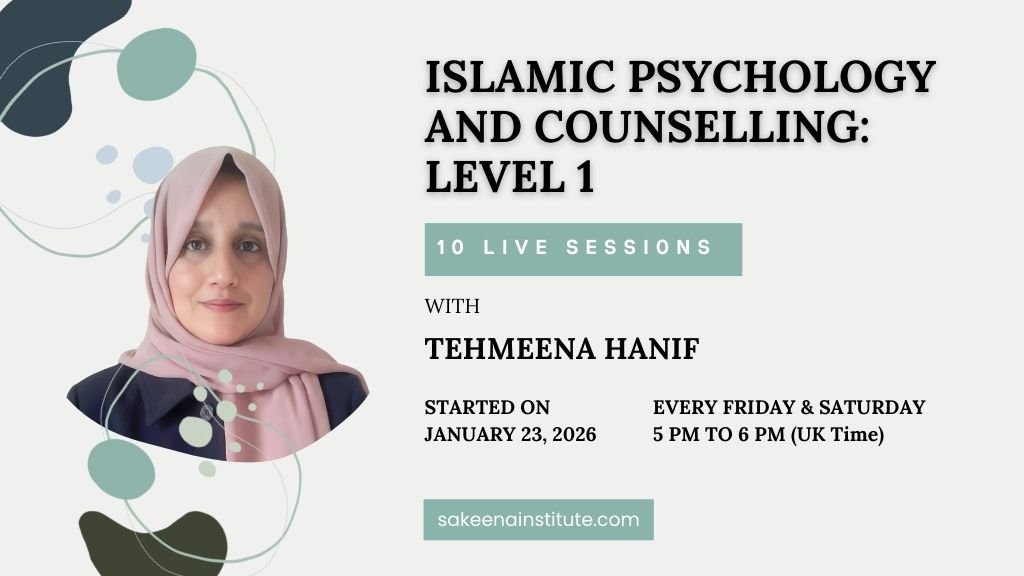
This is a RECORDED course, with no live sessions included. Check our upcoming courses if you prefer live interactions.This Islamic psychology online program offers lifetime access to recorded sessions.

This faith based counselling training introduces the Psychology of the Soul (Ilm al-Nafs). It presents a holistic model that treats humans as a balance of body, mind, and spirit.

Course Overview: Islamic Mental Health Course Rooted in Tradition and Science

Modern psychology often struggles to address spiritual emptiness. This Islamic mental health course provides a structured model that integrates Quranic wisdom, Prophetic guidance, and contemporary psychotherapy.

This Islamic therapy training focuses on developing spiritual and psychological awareness. It supports individuals and Muslim professionals seeking ethical counselling tools.

What Makes This Islamic Counselling Skills Course Unique?

  • Combines Islamic scholarship with evidence-based therapy

  • Provides practical Islamic counselling skills for real-life challenges

  • Offers structured training suitable for beginners and community helpers

  • Builds foundations for advanced Islamic psychology levels 1 2

Course Objectives

By completing this counselling course Islam, you will learn to:

  • Understand Islamic psychology principles and compare them with secular models

  • Identify emotional and spiritual struggles through an Islamic framework

  • Apply psychosocial assessment methods for Muslim clients

  • Practice Islamic mindfulness and contemplative techniques

  • Develop empathy-based counselling skills

  • Recognize when professional referrals are required

Detailed Course Curriculum

Module 1: Foundations of Islamic Psychology Online

Session 1: Introduction to Islamic Psychology

Key Focus

  • History and philosophy of Islamic psychology & counselling course

  • Contributions of scholars like Al-Ghazali and Ibn Sina

  • Spiritual goals including tazkiyat al-nafs and itmi’nan al-qalb

Outcome

Students understand the unique framework of Islamic counselling certification and its modern applications.

Session 2: Understanding Human Structure in Islamic Psychology

Core Components

  • Nafs – Stages from Ammara to Kamilah

  • Qalb – Emotional and spiritual center

  • Aql – Reasoning faculty

  • Ruh – Divine spiritual essence

Outcome

Students map emotional struggles using the Islamic psychological model. This strengthens foundational knowledge for Islamic therapy training.

Module 2: Addressing Inner Emotional and Spiritual Struggles

Session 3: The Psychology of Waswasa

This session explores anxiety and intrusive thoughts using Islamic and cognitive behavioural frameworks.

Key Learning

  • Understanding Waswasa and OCD patterns

  • Islamic coping methods

  • Cognitive restructuring and Exposure Response Prevention (ERP)

Outcome

Students develop practical tools useful in faith based counselling training.

Session 4: Grief, Sadness, and Spiritual Disconnection

Topics Covered

  • Differences between natural grief and clinical depression

  • Islamic concepts of sabr and raja’

  • Integration of dhikr and narrative therapy

Outcome

Participants gain practical skills for emotional healing and community counselling.

Session 5: Anger and Emotional Regulation

Key Techniques

  • Prophetic anger management strategies

  • Dialectical Behaviour Therapy (DBT) skills

  • Long-term emotional self-regulation

Outcome

Students learn anger control strategies aligned with Islamic values and counselling skills Muslim professionals require.

Module 3: Principles of Islamic Counselling Skills Course

Session 6: Ethics and Boundaries in Islamic Counselling

Core Principles

  • Confidentiality (amanah)

  • Compassion (rahmah)

  • Trust building (thiqa)

  • Professional boundary setting

This session is delivered under the academic framework of Sakeena Institute, ensuring professional and spiritual integrity.

Session 7: Deep Listening and Empathic Reflection

Skills Developed

  • Active listening techniques

  • Emotional reflection and summarizing

  • Identifying psychological and spiritual narratives

Outcome

Students improve interpersonal communication and counselling effectiveness.

Session 8: Purposeful Questioning in Counselling

Key Learning

  • Open and closed questioning techniques

  • Socratic questioning methods

  • Hope-focused miracle questions

  • Faith-guided self-discovery

Outcome

Participants gain powerful tools for guiding clients toward solutions rooted in Islamic teachings.

Module 4: Integration and Practical Application

Session 9: Integrating Worship into Therapy

Therapeutic Worship Practices

  • Dhikr for anxiety reduction

  • Dua for grief and emotional pain

  • Mindfulness in Salah (khushu)

  • Personalized worship therapy plans

Outcome

Students learn to create effective spiritual healing programs within Islamic counselling certification practice.

Session 10: Application and Future Pathways

Topics Covered

  • Case study workshops

  • Professional limitations and ethical referrals

  • Roadmap for advanced Islamic psychology levels 1 2

Outcome

Participants leave with a clear development plan supported by Sakeena Institute training pathways.

What You Will Receive

Professional Training Benefits

Live Learning Experience

  • 10 interactive lectures

  • Live Q&A sessions

  • Practical counselling exercises

Study Resources

  • Comprehensive manual and therapy toolkit

  • Worksheets and reflection exercises

  • Spiritual-psychological resource library

Community and Certification

  • Private learning community

  • Official Islamic counselling certification

  • 12-month recording access

Who Should Enroll in This Islamic Counselling Skills Course?

This Islamic mental health course is ideal for:

Personal Development

  • Individuals seeking spiritual and emotional growth

  • Those interested in holistic Islamic self-healing

Professional Development

  • Psychologists and counselling students

  • Teachers and youth mentors

  • Community leaders and volunteers

  • Muslim professionals seeking specialized counselling training

Why Choose This Islamic Psychology & Counselling Course?

This Islamic psychology online program combines traditional Islamic spirituality with modern clinical practice. It equips participants with practical, ethical, and evidence-based counselling skills.

Graduates gain a strong foundation to progress toward advanced Islamic therapy training and professional specialization through Sakeena Institute.

Enrol today and begin your journey to master the art of heart-centered, faith-informed healing and support. You can Join Lecture by this Link: https://us06web.zoom.us/j/82600024321?pwd=E5lNIAsfHIdXv8Js79iP1SGipLhXPD.1

Session 1: Introduction to Islamic Psychology Online – Foundations of the Islamic Counselling Skills Course
 Objective: To establish a clear understanding of Islamic psychology as a distinct, holistic discipline with a rich historical tradition.  Key Concepts: Explore the origins of Islamic psychology in the Quran and Sunnah and the works of early Muslim scholars like Al-Ghazali and Ibn Sina. Differentiate its soul-centric model from purely secular approaches. Discuss its ultimate goal: achieving tranquility of the heart (itmi'nan al-qalb) and purification of the self (tazkiyat al-nafs).  Outcome: You will articulate the unique value proposition of Islamic psychology and its complementary relationship with modern therapeutic models.

  • Introduction to Islamic Psychology: History, Philosophy & Goals
    52:39

Session 2: Understanding Human Structure in Islamic Psychology Levels 1 2 for Counselling Course Islam
 Objective: To comprehend the multi-dimensional Islamic model of the human being and its implications for mental health.  Key Concepts: Undertake a detailed study of the seven stages of the Nafs (from Ammara to Kamilah), the role of the Qalb as the center of faith and emotion, the Aql as the faculty of reasoning, and the Ruh as the divine spirit. Analyze how imbalance in one dimension affects the whole.  Outcome: You will be able to map personal or observed struggles onto this framework, identifying potential root causes in the states of the Nafs or the health of the Qalb.

Session 3: The Psychology of Waswasa in Islamic Mental Health Course and Faith Based Counselling Training
 Objective: To deconstruct anxiety, doubt, and obsessive thoughts from both spiritual and cognitive-behavioral perspectives.  Key Concepts: Examine Waswasa in its clinical dimensions, linking it to concepts like Cognitive Distortions and Obsessive-Compulsive Disorder (OCD). Learn Prophetic strategies for management alongside psychological tools like Cognitive Restructuring and Exposure Response Prevention (ERP) adapted with an Islamic ethos.  Outcome: You will develop a personalized toolkit of spiritual and psychological techniques to manage intrusive thoughts and anxiety.

Session 4: Grief, Sadness, and Spiritual Disconnection in Islamic Therapy Training
 Objective: To normalize and navigate emotions of grief and sadness through an Islamic paradigm, recognizing when they require clinical attention.  Key Concepts: Distinguish between natural grief (huzn), spiritual melancholy, and clinical depression. Study the Islamic narrative of patience (sabr) and hope (raja‘) in times of loss. Integrate therapeutic practices of narrative therapy and behavioral activation with the healing found in prayer, remembrance (dhikr), and community (silah al-rahim).  Outcome: You will gain a compassionate framework to process personal grief and to support others experiencing loss or low mood.

Session 5: Anger and Emotional Regulation for Counselling Skills Muslim Professionals
 Objective: To master the mechanisms of anger and learn Prophetic and psychological methods for self-regulation.  Key Concepts: Analyze the root causes of anger from a neuropsychological and spiritual perspective. Practice specific, Sunnah-based actions to cool anger in the moment. Learn long-term strategies from Dialectical Behavior Therapy (DBT), such as distress tolerance and emotion regulation skills, framed within the Islamic objective of controlling the Nafs.  Outcome: You will acquire immediate and long-term strategies to transform reactive anger into measured, purposeful responses.

Session 6: Ethics and Boundaries in Islamic Counselling Certification and Faith Based Counselling Training
 Objective: To establish the ethical foundation and core conditions for effective, faith-conscious counselling.  Key Concepts: Define the Islamic ethical principles of confidentiality (amanah), empathy (rahmah), and non-judgment. Learn to set and maintain healthy professional boundaries. Explore the critical skill of building rapport and trust (thiqa) with a client/seekers, creating a safe spiritual and emotional space.  Outcome: You will be able to establish a helping relationship that is both professionally sound and spiritually aligned.

Session 7: Deep Listening and Empathic Reflection in Islamic Counselling Skills Course
 Objective: To move beyond passive hearing to active, transformative listening.  Key Concepts: Master the micro-skills of active listening: attending behavior, paraphrasing, and summarizing. Learn the technique of empathic reflection, mirroring both content and emotion, to make a seeker feel profoundly understood. Understand how to listen for both psychological and spiritual themes in a narrative.  Outcome: You will enhance your communication in all relationships and be able to facilitate deeper self-awareness in others through reflective listening.

Session 8: Purposeful Questioning in Counselling Course Islam for Muslim Professionals
 Objective: To use strategic questioning to guide self-discovery and solution-building.  Key Concepts: Differentiate between closed, open, and circular questions. Practice Socratic questioning to challenge unhelpful beliefs and "Miracle Questions" to build hope and envision change, all while steering the conversation towards Islamic sources of strength and wisdom.  Outcome: You will learn to ask empowering questions that help others uncover their own resources and solutions, guided by faith.

Session 9: Integrating Worship into Therapy in Islamic Mental Health Course and Islamic Therapy Training
 Objective: To map specific Islamic worships as direct, therapeutic interventions for psychological states.  Key Concepts: Prescribe dhikr for anxiety and distraction, therapeutic dua for grief and helplessness, and mindfulness in prayer (khushu) for grounding and focus. Learn how to collaboratively design a "Worship Prescription" that addresses specific emotional or behavioral challenges.  Outcome: You will be able to creatively and appropriately integrate acts of worship into a holistic healing plan for yourself or others.

Session 10: Application and Future Pathways in Islamic Counselling Certification and Islamic Psychology Levels
 Objective: To consolidate learning and create a practical roadmap for ongoing development and application.  Key Concepts: Review the complete integrated model. Workshop real-world scenarios to apply the full spectrum of skills. Discuss the limits of this foundational training and pathways for further study in Islamic counselling or psychology. Create a personalized action plan.  Outcome: You will leave with confidence in your new knowledge, a clear plan for its application, and an understanding of how to continue your professional or personal development in this field.

Student Ratings & Reviews

No Review Yet
No Review Yet

Apply now for our education support scholarship.

Stay Tuned!
No Scholorship is available for this course at the moment.

$95.00
10 Lessons
5 Weeks
Friday & Saturday 5pm (UK Time)
1 hour per session
$95

Want to receive push notifications for all major on-site activities?

Welcome Back!
Log in to Continue Learning

Having Trouble Signing In? Login Here

New Here?
Create an Account & Get Started

Having Trouble Signing Up? Register here in new page
By signing up, I agree with the website's Terms and Conditions

Struggling with your mental health? Book your private consultation with our specialists.